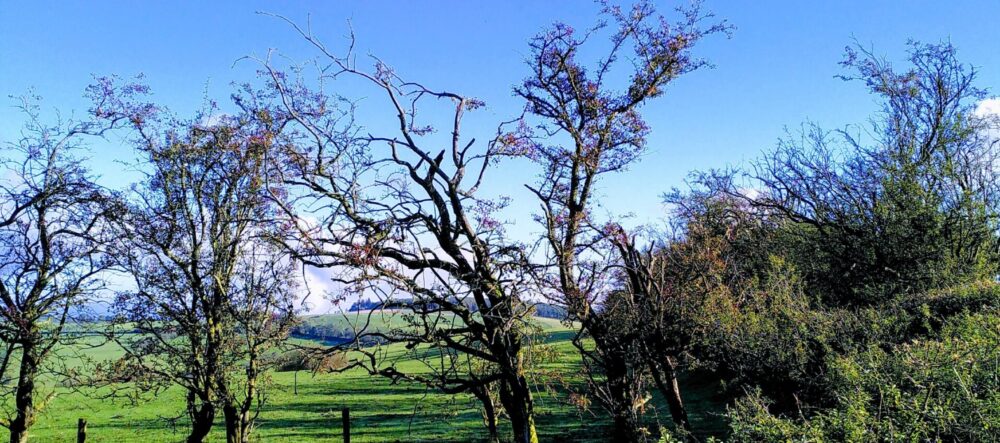

A trip long in the planning
Last summer, I was staying in Devon with my good friend Alice (a keen walker) who showed me some wonderful Dartmoor walks in what turned out to be some of the best weather of the year. This inspired us to think of doing something more ambitious over several days, and eventually we settled on the Llyn Peninsula in North Wales, somewhere neither of us had been to before, where I had long wanted to visit. We decided to go early May, avoiding bank holiday crowds and hoping for some good early summer weather.
I offered to take on the bulk of the planning, as I live on the border with Wales, and many of my local walking friends know and love the area, giving me invaluable tips about where to go. Booking accommodation was the first priority, as it soon became clear that the Llyn is sparsely populated and towns and villages are few and far between. We decided to walk the western length of the peninsula, which is wilder and most spectacular, but well served by the Wales Coastal Path. Combining public transport with walking, we could do a linear route without having to go back to our starting point.
Our route would be dictated by where we could stay, and hopefully walk between in the period of a day. Thankfully we found accommodation in Caernarfon (our starting point), Nefyn, Tudweiliog and Aberdaron, averaging around 8-10 miles per day which was perfectly doable. Booking well in advance, we were at least sure we’d have somewhere to sleep each night after a long day’s walking.
Along the route, we were treated to spectacular scenery, enjoyed to the max due to clear sunny weather throughout. The sunsets were some of the best I’ve seen anywhere, and the wildlife just kept on coming – seals, oyster catchers, stonechats, hares, and some particularly joyful swallows along the waterfront in Caernarfon. There were wild flowers everywhere including thrift, buttercups, foxgloves and countless others at their best this time of year. And the people were lovely, helpful, welcoming and friendly: This being a Welsh-as-first-language area, we found everyone switched easily to English for our benefit, with none of the “anti-English” attitudes we hear about so often. It was great to hear Welsh spoken as the default language, with the staff in shops, hotels and cafes all sounding local. We really did feel as though we were in a different country (which of course we were!) and a very welcoming one at that.
This blog is a bit of a long one, for which I make no apologies: This trip was really special, and what I’ve tried to capture here is the magical beauty of the place, as well as some ideas how to get around and where to stay. I’ve put links in the post to the places we stayed and ate. I strongly recommend booking accommodation and food in advance, to save hassle when you arrive.
If you haven’t been to Llyn, you must go: this place is pure magic!
Day 1: Bangor and Caernarfon
We started by getting the train from my local station at Gobowen to Bangor, which is the furthest we could go along the North Wales coast line before it heads over the Menai Strait to Anglesey.
Bangor, it turns out, has little to draw the casual visitor. Apart from the C6th Cathedral (one of the oldest places of worship in Wales), and the University which sits rather aloof on the hill above the town, there’s not a lot else apart from a long and dispiriting high street. The town seems to be struggling, with empty shops and little sign of the university boosting the local economy. We had a quick look around the Cathedral then ate lunch there, more out of principle to spend money in the town than any desire to prolong our visit. Fortunately buses to our next destination, Caernarfon, are every 15 minutes so we headed for the bus stop as soon as we’d settled the bill.
The bus driver was, without doubt, one of the miserable people I’ve ever had the misfortune to deal with. I thought at first it was because we were English, but soon realised he was equally grumpy with everyone, so that cheered me right up.
Half an hour later, we arrived in Caernarfon which, after Bangor, was quite a relief. This small town sits in the shadow of its vast castle, with a bustling market in the town square. We checked in to our hotel and set off to explore the town. Set on the Menai Strait opposite Anglesey, against the backdrop of the Snowdonia mountains, this town is an absolute gem. Fishing boats bob in the pretty harbour, while sleek yachts glisten in the well kept marina. There are plenty of interesting independent shops offering lots to explore for locals and visitors alike – including a Japanese-inspired Saori weaving workshop run by a lovely lady who gave us a fascinating insight into the art of freestyle weaving!
After a delightful evening meal overlooking the marina, we walked along the river front enjoying a spectacular sunset over Angelsey, enjoying the swallows swooping overhead, catching their evening meal.
We stayed at Travel Lodge Caernarfon https://www.travelodge.co.uk/hotels/392/Caernarfon-hotel?msockid=21bccd9dfcc46d003aced839fd7f6c77 and ate dinner and breakfast at Harbour Table Table https://www.tabletable.co.uk/en-gb/locations/gwynedd/the-harbour?cid=yext_41526670


Day 2: Caernarfon to Nefyn – walking distance around 10 miles, challenging in places
After a fairly brisk start and breakfast, we caught the bus for the 40 minute ride to the starting point of our walk, at Trefor on the northern coast of the peninsula. Luckily the driver was as cheery and obliging as the previous day’s guy was miserable, and made sure we got off at the right place. Trefor is the last stop on the bus route along the north coast before it swings south to Pwllheli, and forms the gateway to the western part of the Llyn.
This is a rugged landscape of old quarries and Iron Age hilltop settlements, a rich history I fully intend to explore some day. Slightly daunted by the prospect of scaling the range of hills known as Yr Eifl (The Rivals in English) in order to get to where we were headed, we struck off straight away towards the coll (or saddle) between two of the hills which string across the neck of the peninsula. It was certainly a long steep haul, but taking it steady, with plenty of breaks to look back at the wonderful coastline as we climbed above it, made it well worth the effort.
We decided to take a longer route and drop down to the former quarrying village of Nant Gwrtheyrn, set on the coast at the end of a secluded valley below Yr Eifl. Disused as an industrial village since the early C20th and apparently destoyed by hippies in the 1960s, it was rescued from dereliction in the 1970s and is now a Welsh Cultural and Language centre, with the workers cottages now restored for visitor accommodation. The village has been brilliantly repurposed for modern day visitors, and is well worth a visit. After a leisurely picnic lunch and coffee in the lovely cafe overlooking the sea, we set off on another long haul up the cliffs and through the woods to rejoin the clifftop path.
Our next stop was St. Bueno’s chapel at Pistyll, a popular stop off for pilgrims along the North Wales Pilgrim’s way, which joins the coastal path at various points along our route. After a long hot walk, it was bliss to be in this cool and peaceful space, with sunlight streaming in the door and (for some reason!) straw scattered on the floor throughout.
After a breather and a quick fret over an emerging blister on my little toe, we continued along the lanes for the last stretch of the walk to the pretty village of Nefyn, our stop for the night. We stayed and ate at the very pleasant Nanhoron Arms in Nefyn, where they kindly dug out a couple of plasters for me!
Nant Gwrtheyrn https://nantgwrtheyrn.org/ St. Bueno’s Church, Pistyll https://www.britishpilgrimage.org/places/st-beunos-church-and-holy-well-pistyll Nanhoron Arms Hotel https://www.nanhoronhotel.com/


Day 3: Nefyn to Tudweiliog – about 8 miles along the coast, moderate
Picking up the coastal path again, going west, we skirted the pretty sandy peninsula of Morfa Nefyn and crossed the popular Nefyn golf course. Having managed to avoid too many golf balls whistling past our ears, we dropped down into a secluded sandy cove for a snack and a paddle, joined by the ubiquitous oyster catchers and various other sea birds.
In contrast to the previous stretch, this is a coastline full of golden sandy beaches and deserted rocky coves – straight out of a Famous Five adventure! From there, it was a relatively easy walk, via some basking seals on the rocks below, along the path hugging the coast. We turned inland at the sandy beach at Towyn, stopped for a quick cup of tea in a very nice cafe / shop at the camp site, and made the short walk to the village of Tudweiliog where we were staying that night at the Lion Hotel.
After a slightly worrying start, arriving at the hotel around 4 pm to find it completely deserted, we eventually raised someone to come and open up for us. Apparently they don’t open until 5 pm, but nobody thought to tell us! To our relief, the place was clean, comfortable and welcoming. After five, the place sprung to life, and we enjoyed a convivial evening in the bar, over an excellent meal and a well earned glass of wine. It turns out this is a popular place for people staying at the nearby caravan park. As on the previous two nights, we enjoyed the gorgeous sunset afterwards. Breakfast the next morning was well up to scratch (we were the only people staying there!) and we headed off on our final day’s walk to Aberdaron.
We stayed at the Lion Hotel in Tudweiliog https://lionhoteltudweiliog.co.uk/


Day 4: Tudweiliog to Aberdaron – about 10 miles on coast and lanes, moderate
We decided to deviate from the coastal path on this final stretch, as the full route round is about 17 miles and would be a bit of a slog involving almost doubling back on ourselves round the end of the peninsula towards our final overnight stop in the village of Aberdaron.
The peninsula is very narrow at this point, so our plan was to follow the northern coast to Porth Oer (Whistling Sands in English) then cut through the lanes and drop down to Aberdaron from the north. This turned out to be a good call, as Porth Oer is beautiful, with a golden sandy beach below thrift-topped cliffs. There’s also a nice cafe / shop on the beach, a perfect stopping off point for tea and home made carrot cake before the final leg of our walk. We got from Porth Oer to Aberdaron on the south coast in a leisurely hour or so, arriving in plenty of time to check in to our hotel and explore the village in the sunshine.
Aberdaron is a lively place, popular with holidaymakers, many of whom seemed local judging by the amount of Welsh we heard spoken throughout the village. It is also the final stopping off point for pilgrims on their way to Bardsey Island, around 20 minutes away by boat. We didn’t have time to make the crossing, but Bardsey has been a significant destination for holy men and pilgrims since around the C6th, and is a wild and beautiful place. It is claimed that the bones of 20,000 saints are buried there, and that 2 pilgrimages to Bardsey equal 1 pilgrimage to Rome. If that’s your thing.
There is a church popular with pilgrims right on the beach in the village, with a steep and well populated church yard and magnificent views of Aberdaron bay. We had a very comfortable night, and a great meal at the Gwesty Ty Newydd hotel – we had two of the best rooms overlooking the beach. I fell asleep that night listening to the waves lapping the beach with the nearly full moon shimmering over the water. A perfect last night of the holiday!
https://www.gwesty-tynewydd.co.uk/


Day 5: Aberdaron and home
After a slightly rushed breakfast the next morning, we caught the bus from Aberdaron to Pwllheli, which took around 40 minutes. The fun thing about getting local buses and trains is that you get a good feel for the area, way more fun that driving through in a car. A group of 4 convivial older ladies, visitors from northern England by the sounds of it, climbed on board with us and ensured a cheerful journey! We arrived in the lively and busy resort of Pwllheli in plenty of time for our train to Shrewsbury – this being the beginning of the line from the Llyn into “mainland” Wales and on into England.
The journey was slow, with 30 stops between Pwllheli and Shrewsbury. Many of the stops are request stops, so if the train stops at all of them (it did – the sunny weather was bringing everyone out for the day), it can make the journey considerably longer. This suited us fine, as the scenery was stunning every inch of the way, as we followed the south coast of Llyn and down the opposite coast of North Wales, looking back at where we’d been. Then turning east and inland across Wales to Shrewsbury. It was great to hear many of the tourists speaking Welsh, with little English heard until we got back towards the border and into England.
We then had a change at Shrewsbury for our train back to Gobowen, and we were home – the journey having taken most of the day. It was a wonderful holiday, in a really special place. I would do any or all of it again, and fully plan to do so, one day…!


